GitLab Dedicated network access and security
- Tier: Ultimate
- Offering: GitLab Dedicated
Custom domains
You can configure a custom domain to access your GitLab Dedicated
instance instead of the default your-tenant.gitlab-dedicated.com.
When you add a custom domain:
- The domain is included in the external URL used to access your instance.
- Any connections to your instance using the default
tenant.gitlab-dedicated.comdomain are no longer available.
GitLab automatically manages SSL/TLS certificates for your custom domain using Let's Encrypt. Let's Encrypt uses the HTTP-01 challenge to verify domain ownership, which requires:
- The CNAME record to be publicly resolvable through DNS.
- The same public validation process for automatic certificate renewal every 90 days.
For instances configured with private networking (such as AWS PrivateLink), public DNS resolution ensures certificate management works properly, even when all other access is restricted to private networks.
GitLab Dedicated supports custom domains through two configuration methods:
- Standard configuration: Uses CNAME records and Let's Encrypt certificates. You configure your own DNS records and request domain activation through support.
- Cloudflare security configuration: Uses NS records and Let's Encrypt certificates. GitLab provides DNS configuration details and you implement them in coordination with support.
Contact your Customer Success Manager to determine which configuration method applies to your instance.
Standard configuration
With this configuration, your domain connects directly to your GitLab instance using a CNAME record. GitLab automatically manages SSL certificates using Let's Encrypt, which verifies domain ownership through public DNS lookups and renews certificates automatically every 90 days.
Your custom domain must be accessible from the public internet for SSL certificate management, even if you access your instance through private networks.
For instances configured with private networking (such as AWS PrivateLink), public DNS access ensures certificate management works properly, even when all other access is restricted to private networks.
Configure DNS records
Prerequisites:
- Access to your domain host's DNS settings.
To configure DNS records:
-
Sign in to your domain host's website.
-
Go to the DNS settings.
-
Add a
CNAMErecord that points your custom domain to your GitLab Dedicated instance. For example:gitlab.my-company.com. CNAME my-tenant.gitlab-dedicated.com -
Optional. If your domain has an existing
CAArecord, update it to include Let's Encrypt as a valid certificate authority. For example:gitlab.my-company.com. IN CAA 0 issue "pki.goog" gitlab.my-company.com. IN CAA 0 issue "letsencrypt.org"The
CAArecord defines which certificate authorities can issue certificates for your domain. -
Save your changes and wait for DNS changes to take effect.
Keep your DNS records in place as long as you use the custom domain.
Enable a custom domain
Prerequisites:
- You have configured the DNS records.
To enable your custom domain:
- Submit a support ticket.
- In your support ticket, specify:
- Your custom domain name. For example,
gitlab.company.com. - If you need custom domains for the container registry and GitLab agent server for Kubernetes, include the domain names you want to use.
For example,
registry.company.comandkas.company.com.
- Your custom domain name. For example,
Cloudflare security configuration
With this configuration, your domain must be delegated to GitLab using NS records, which allows traffic to be routed through Cloudflare Web Application Firewall (WAF). Cloudflare manages all DNS settings for your domain and provides enhanced security features.
Note
This approach requires coordination with your Customer Success Manager. The configuration is applied during your instance's maintenance period.
Request a custom domain
To request a custom domain:
- Submit a support ticket.
- In your support ticket, specify:
- Your custom domain name. For example,
gitlab.company.com. - If you need custom domains for the container registry and GitLab agent server for Kubernetes, include the domain names you want to use.
For example,
registry.company.comandkas.company.com. - Your compliance requirements. For example, FedRAMP.
- Your custom domain name. For example,
GitLab configures your domain in Cloudflare and provides:
- Two Cloudflare nameservers, like
name1.ns.cloudflare.comandname2.ns.cloudflare.com. - DNSSEC parameters (FedRAMP customers only), including:
- Key tag: Numeric identifier (provided by GitLab)
- Algorithm: Typically 13 (ECDSA P-256 with SHA-256) or 8 (RSA/SHA-256)
- Digest type: Typically 2 (SHA-256)
- Digest: Cryptographic hash of the public key (provided by GitLab)
Configure DNS records
Configure NS records in your DNS provider to delegate your subdomain to Cloudflare.
Prerequisites:
- Access to your domain host's DNS settings.
- GitLab has provided nameservers and DNSSEC parameters (if applicable).
To configure DNS records:
-
Sign in to your domain host's website.
-
Go to the DNS settings.
-
Create NS records using the nameservers provided by GitLab. For example:
gitlab.company.com. NS name1.ns.cloudflare.com. gitlab.company.com. NS name2.ns.cloudflare.com. -
Remove any conflicting A, AAAA, or CNAME records for the same subdomain.
-
FedRAMP customers only. Add a DS record using the values provided by GitLab:
gitlab.company.com. DS [Key Tag] [Algorithm] [Digest Type] [Digest]For example:
gitlab.company.com. DS 12345 13 2 A1B2C3D4E5F6... -
Save your changes. DNS changes can take up to 48 hours to take effect.
-
Verify your configuration:
# Verify nameserver delegation dig +short NS gitlab.company.com # Verify DNS resolution dig gitlab.company.com # Verify DNSSEC (if configured) dig +dnssec gitlab.company.com -
Notify GitLab through your support ticket that DNS configuration is complete.
GitLab then:
- Verifies DNS delegation.
- Configures SSL/TLS certificates.
- Confirms when your custom domain is active.
Custom certificate authorities for external services
GitLab Dedicated validates certificates when connecting to external services over HTTPS. By default, GitLab Dedicated trusts only publicly recognized certificate authorities and rejects connections to services with certificates from untrusted certificate authorities.
If your external services use certificates from a private or internal certificate authority, you must add that certificate authority to your GitLab Dedicated instance.
You might need custom certificate authorities to:
- Connect to internal webhook endpoints
- Pull images from private container registries
- Integrate with on-premises services behind corporate public key infrastructure
Add a custom certificate
Certificate chain blocks (multiple certificates in a single text block) are not supported. If you have multiple certificates in your chain, add each certificate separately.
To add a custom certificate:
- Sign in to Switchboard.
- At the top of the page, select Configuration.
- Expand Custom certificates.
- Select + Add Certificate.
- Paste a single certificate into the text box. Include the
-----BEGIN CERTIFICATE-----and-----END CERTIFICATE-----lines. - Select Save.
- Repeat steps 4-6 for each additional certificate in your chain.
- Scroll up to the top of the page and select whether to apply the changes immediately or during the next maintenance window.
If you cannot use Switchboard to add a custom certificate, open a support ticket and attach each custom certificate as a separate file.
AWS Private Link connectivity
Inbound Private Link
AWS Private Link allows users and applications in your VPC on AWS to securely connect to the GitLab Dedicated endpoint without network traffic going over the public internet.
You can create private links only in your primary and secondary AWS regions where your GitLab Dedicated instance is deployed.
When you create a private link, you specify IAM principals that control access. Only the IAM principals you specify can create VPC endpoints to connect to your instance.
The endpoint service is available in two availability zones that are either chosen during onboarding or randomly selected.
Prerequisites:
- Your VPC must be in the same region as your GitLab Dedicated instance.
- Use IAM principals with role names only. Do not include role paths.
- Valid:
arn:aws:iam::AWS_ACCOUNT_ID:role/RoleName - Invalid:
arn:aws:iam::AWS_ACCOUNT_ID:role/somepath/AnotherRoleName
- Valid:
To create an inbound private link:
-
Sign in to Switchboard.
-
At the top of the page, select Configuration.
-
Expand Inbound private link.
-
Select Add endpoint service. This button is not available if all your available regions already have private links.
-
Select a region.
-
Add IAM principals for the AWS users or roles in your AWS organization that are establishing the VPC endpoints. The IAM principals must be IAM role principals or IAM user principals.
-
Select Save.
-
GitLab creates the endpoint service and handles domain verification for private DNS. The service endpoint name becomes available on the Configuration page.
-
In your AWS account, create an endpoint interface in your VPC.
-
Configure the endpoint interface with these settings:
- Service endpoint name: Use the name from the Configuration page in Switchboard.
- Private DNS names enabled: Select Yes.
- Subnets: Select all matching subnets.
-
Use the instance URL provided during onboarding to connect to your GitLab Dedicated instance from your VPC.
Enable KAS and registry for Inbound Private Link
When you use Inbound Private Link to connect to your GitLab Dedicated instance, only the main instance URL has automatic DNS resolution through the private network.
To access KAS (GitLab agent for Kubernetes) and registry services through your private network, you must create an additional DNS configuration in your VPC.
Prerequisites:
- You have configured Inbound Private Link for your GitLab Dedicated instance.
- You have permissions to create Route 53 private hosted zones in your AWS account.
To enable KAS and registry through your private network:
-
In your AWS console, create a private hosted zone for
gitlab-dedicated.comand associate it with the VPC that contains your private link connection. -
After you create the private hosted zone, add the following DNS records (replace
examplewith your instance name):-
Create an
Arecord for your GitLab Dedicated instance:-
Configure your full instance domain (for example,
example.gitlab-dedicated.com) to resolve to your VPC endpoint as an Alias. -
Select the VPC endpoint that does not contain an Availability Zone reference.

-
-
Create
CNAMErecords for both KAS and the registry to resolve to your GitLab Dedicated instance domain (example.gitlab-dedicated.com):kas.example.gitlab-dedicated.comregistry.example.gitlab-dedicated.com
-
-
To verify connectivity, from a resource in your VPC, run these commands:
nslookup kas.example.gitlab-dedicated.com
nslookup registry.example.gitlab-dedicated.com
nslookup example.gitlab-dedicated.com
All commands should resolve to private IP addresses within your VPC.
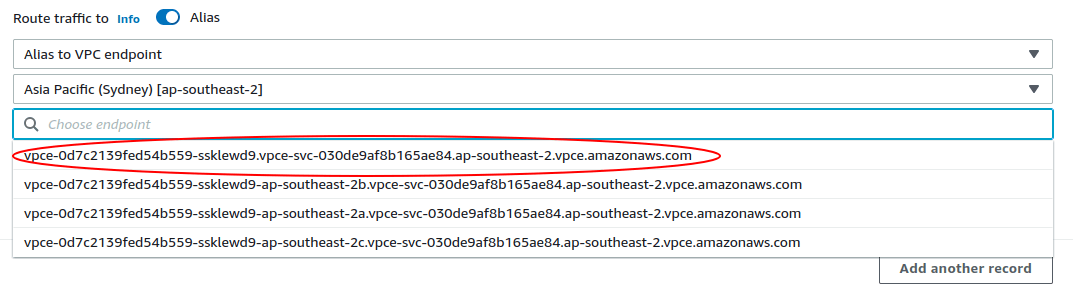
This configuration is robust to IP address changes because it uses the VPC endpoint interface rather than specific IP addresses.
Enable Pages for Inbound Private Link
Access GitLab Pages through your private network by creating additional DNS configuration in your VPC, similar to the KAS and registry configuration.
To enable Pages through your private network:
- In your AWS console, create a private hosted zone for
<your_instance_name>.gitlab-pages.siteand associate it with the VPC that contains your private link connection. - After you create the private hosted zone, add the following DNS records:
- Create an apex
Aalias record for the VPC endpoint. - Create a wildcard
CNAMEfor*.<your_instance_name>.gitlab-pages.sitethat points to<your_instance_name>.gitlab-pages.site.
- Create an apex
Troubleshooting
Error: Service name could not be verified
You might get an error that states Service name could not be verified when trying to create a VPC endpoint.
This issue occurs when the custom IAM role provided in the support ticket does not have the proper permissions or trust policies configured in your AWS account.
To resolve this issue:
-
Confirm that you can assume the custom IAM role provided to GitLab in the support ticket.
-
Verify the custom role has a trust policy that allows you to assume it. For example:
{ "Version": "2012-10-17", "Statement": [ { "Sid": "Statement1", "Effect": "Allow", "Principal": { "AWS": "arn:aws:iam::CONSUMER_ACCOUNT_ID:user/user-name" }, "Action": "sts:AssumeRole" } ] } -
Verify the custom role has a permission policy that allows VPC endpoint and EC2 actions. For example:
{ "Version": "2012-10-17", "Statement": [ { "Sid": "VisualEditor0", "Effect": "Allow", "Action": "vpce:*", "Resource": "*" }, { "Sid": "Statement1", "Effect": "Allow", "Action": [ "ec2:CreateVpcEndpoint", "ec2:DescribeVpcEndpointServices", "ec2:DescribeVpcEndpoints" ], "Resource": "*" } ] } -
Using the custom role, retry creating the VPC endpoint in your AWS console or CLI.
Outbound Private Link
Outbound private links allow your GitLab Dedicated instance and the hosted runners for GitLab Dedicated to securely communicate with services running in your VPC on AWS without exposing any traffic to the public internet.
This type of connection allows GitLab functionality to access private services:
-
For the GitLab Dedicated instance:
- webhooks
- import or mirror projects and repositories
-
For hosted runners:
- custom secrets managers
- artifacts or job images stored in your infrastructure
- deployments into your infrastructure
Consider the following:
- You can only create private links within the same AWS region. Make sure your VPC is in the same region where your GitLab Dedicated instance is deployed.
- The connection requires the Availability Zone IDs (AZ IDs) for the two Availability Zones (AZs) in the regions that you selected during onboarding.
- If you did not specify any AZs during onboarding to Dedicated, GitLab randomly selects both AZ IDs. AZ IDs are displayed in Switchboard on the Overview page for both the Primary and Secondary regions.
- GitLab Dedicated limits the number of outbound private link connections to 10.
Add an outbound private link with Switchboard
Prerequisites:
-
Create the endpoint service for your internal service to be available to GitLab Dedicated.
-
Configure a Network Load Balancer (NLB) for the endpoint service in the Availability Zones (AZs) where your Dedicated instance is deployed. Either:
- Use the configured AZs. AZ IDs are displayed on the Overview page in Switchboard.
- Enable the NLB in every AZ in the region.
-
Add the ARN of the role that GitLab Dedicated uses to connect to your endpoint service to the Allowed Principals list on the Endpoint Service. You can find this ARN in Switchboard under Outbound private link IAM principal. For more information, see Manage permissions.
-
Recommended. Set Acceptance required to No to enable GitLab Dedicated to connect in a single operation. If set to Yes, you must manually accept the connection after it's initiated.
If you set Acceptance required to Yes, Switchboard cannot accurately determine when the link is accepted. After you manually accept the link, the status shows as Pending instead of Active until next scheduled maintenance. After maintenance, the link status refreshes and shows as connected.
-
Once the endpoint service is created, note the Service Name and if you have enabled Private DNS or not.
- Sign in to Switchboard.
- At the top of the page, select Configuration.
- Expand Outbound private link.
- Complete the fields.
- To add endpoint services, select Add endpoint service. You can add up to ten endpoint services for each region. At least one endpoint service is required to save the region.
- Select Save.
- Optional. To add an outbound private link for a second region, select Add outbound connection, then repeat the previous steps.
Delete an outbound private link with Switchboard
- Sign in to Switchboard.
- At the top of the page, select Configuration.
- Expand Outbound private link.
- Go to the outbound private link you want to delete, then select Delete ({remove}).
- Select Delete.
- Optional. To delete all the links in a region, from the region header, select Delete ({remove}). This also deletes the region configuration.
Add an outbound private link with a support request
-
Create the Endpoint service through which your internal service
will be available to GitLab Dedicated. Provide the associated
Service Endpoint Nameon a new support ticket. - Configure a Network Load Balancer (NLB) for the endpoint service in the Availability Zones (AZs) where your Dedicated instance is deployed. Either:
- Use the configured AZs. AZ IDs are displayed on the Overview page in Switchboard.
- Enable the NLB in every AZ in the region.
- In your support ticket, GitLab will provide you with the ARN of an
IAM role that will be initiating the connection to your endpoint service. You must ensure this ARN is included, or otherwise covered by other
entries, in the list of "Allowed Principals" on the Endpoint Service, as described by the AWS documentation.
Though it's optional, you should you add it explicitly, allowing you to set
Acceptance requiredto No so that Dedicated can connect in a single operation. If you leaveAcceptance requiredas Yes, then you must manually accept the connection after Dedicated has initiated it. - To connect to services using the Endpoint, the Dedicated services require a DNS name. Private Link automatically creates an internal name, but
it is machine-generated and not generally directly useful. Two options are available:
- In your Endpoint Service, enable Private DNS name, perform the
required validation, and let GitLab know in the support ticket that you are using this option. If
Acceptance Requiredis set to Yes on your Endpoint Service, also note this on the support ticket because Dedicated will have to initiate the connection without Private DNS, wait for you to confirm it has been accepted, and then update the connection to enable the use of Private DNS. - Dedicated can manage a Private Hosted Zone (PHZ) within the Dedicated AWS Account and alias any arbitrary DNS names to the endpoint, directing requests for those names to your endpoint service. These aliases are known as PHZ entries. For more information, see Private hosted zones.
- In your Endpoint Service, enable Private DNS name, perform the
required validation, and let GitLab know in the support ticket that you are using this option. If
GitLab then configures the tenant instance to create the necessary Endpoint Interfaces based on the service names you provided. Any matching outbound connections made from the tenant instance are directed through the PrivateLink into your VPC.
Troubleshooting
If you have trouble establishing a connection after the Outbound Private Link has been set up, a few things in your AWS infrastructure could be the cause of the problem. The specific things to check vary based on the unexpected behavior you're seeking to fix. Things to check include:
- Ensure that cross-zone load balancing is turned on in your Network Load Balancer (NLB).
- Ensure that the Inbound Rules section of the appropriate Security Groups permits traffic from the correct IP ranges.
- Ensure that the inbound traffic is mapped to the correct port on the Endpoint Service.
- In Switchboard, expand Outbound private link and confirm that the details appear as you expect.
- Ensure that you have allowed requests to the local network from webhooks and integrations.
Private hosted zones
A private hosted zone (PHZ) creates custom DNS aliases (CNAMEs) that resolve in your GitLab Dedicated instance's network.
Use a PHZ when you want to:
- Create multiple DNS names or aliases that use a single endpoint, such as when running a reverse proxy to connect to multiple services.
- Use a private domain that cannot be validated by public DNS.
PHZs are commonly used with reverse PrivateLink to create readable domain names instead of using AWS-generated endpoint names. For example, you can use alpha.beta.tenant.gitlab-dedicated.com instead of vpce-0987654321fedcba0-k99y1abc.vpce-svc-0a123bcd4e5f678gh.eu-west-1.vpce.amazonaws.com.
In some cases, you can also use PHZs to create aliases that resolve to publicly accessible DNS names. For example, you can create an internal DNS name that resolves to a public endpoint when you need internal systems to access a service through its private name.
Note
Changes to private hosted zones can disrupt services that use these records for up to five minutes.
PHZ domain structure
When using your GitLab Dedicated instance's domain as part of an alias, you must include two subdomains before the main domain, where:
- The first subdomain becomes the name of the PHZ.
- The second subdomain becomes the record entry for the alias.
For example:
- Valid PHZ entry:
subdomain2.subdomain1.<your-tenant-id>.gitlab-dedicated.com. - Invalid PHZ entry:
subdomain1.<your-tenant-id>.gitlab-dedicated.com.
When not using your GitLab Dedicated instance domain, you must still provide:
- A Private Hosted Zone (PHZ) name
- A PHZ entry in the format
phz-entry.phz-name.com
To prevent shadowing of public DNS domains when the domain is created inside the Dedicated tenant, use at least two additional subdomain levels below any public domain for your PHZ entries. For example, if your tenant is hosted at tenant.gitlab-dedicated.com, your PHZ entry should be at least subdomain1.subdomain2.tenant.gitlab-dedicated.com, or if you own customer.com then at least subdomain1.subdomain2.customer.com, where subdomain2 is not a public domain.
Add a private hosted zone with Switchboard
To add a private hosted zone:
- Sign in to Switchboard.
- At the top of the page, select Configuration.
- Expand Private hosted zones.
- Select Add private hosted zone entry.
- Complete the fields.
- In the Hostname field, enter your Private Hosted Zone (PHZ) entry.
- For Link type, choose one of the following:
- For an outbound private link PHZ entry, select the endpoint service from the dropdown list.
Only links with the
AvailableorPending Acceptancestatus are shown. - For other PHZ entries, provide a list of DNS aliases.
- For an outbound private link PHZ entry, select the endpoint service from the dropdown list.
Only links with the
- Select Save. Your PHZ entry and any aliases should appear in the list.
- Scroll to the top of the page, and select whether to apply the changes immediately or during the next maintenance window.
Add a private hosted zone with a support request
If you are unable to use Switchboard to add a private hosted zone, you can open a support ticket and provide a list of DNS names that should resolve to the endpoint service for the outbound private link. The list can be updated as needed.
IP allowlist
Control which IP addresses can access your instance with an IP allowlist.
When you enable the IP allowlist, IP addresses not on the allowlist are blocked
and receive an HTTP 403 Forbidden response when they try to access your instance.
Use Switchboard to configure and manage your IP allowlist, or submit a support request if Switchboard is unavailable.
Add IP addresses to the allowlist with Switchboard
To add IP addresses to the allowlist:
-
Sign in to Switchboard.
-
At the top of the page, select Configuration.
-
Expand IP allowlist, then select IP allowlist to go to the IP allowlist page.
-
To enable the IP allowlist, select the vertical ellipsis ({ellipsis_v}), then select Enabled.
-
Do one of the following:
- To add a single IP address:
- Select Add IP address.
- In the IP address text box, enter either:
- A single IPv4 address (for example,
192.168.1.1). - An IPv4 address range in CIDR notation (for example,
192.168.1.0/24).
- A single IPv4 address (for example,
- In the Description text box, enter a description.
- Select Add.
- To import multiple IP addresses:
- Select Import.
- Upload a CSV file or paste a list of IP addresses.
- Select Continue.
- Fix any invalid or duplicate entries, then select Continue.
- Review the changes, then select Import.
-
At the top of the page, choose whether to apply the changes immediately or during the next maintenance window.
Delete IP addresses from the allowlist with Switchboard
-
Sign in to Switchboard.
-
At the top of the page, select Configuration.
-
Expand IP allowlist, then select IP allowlist to go to the IP allowlist page.
-
Do one of the following:
- To delete a single IP address:
- Next to the IP address you want to remove, select the trash icon ({remove}).
- Select Delete IP address.
- To delete multiple IP addresses:
- Select the checkboxes for the IP addresses you want to delete.
- To select all IP addresses on the current page, select the checkbox in the header row.
- Above the IP addresses table, select Delete.
- Select Delete to confirm.
-
At the top of the page, choose whether to apply the changes immediately or during the next maintenance window.
Add an IP to the allowlist with a support request
If you are unable to use Switchboard to update your IP allowlist, open a support ticket and specify a comma-separated list of IP addresses that can access your instance.
Enable OpenID Connect for your IP allowlist
Using GitLab as an OpenID Connect identity provider requires internet access to the OpenID Connect verification endpoint.
To enable access to the OpenID Connect endpoint while maintaining your IP allowlist:
- In a support ticket, request to allow access to the OpenID Connect endpoint.
The configuration is applied during the next maintenance window.
Enable SCIM provisioning for your IP allowlist
You can use SCIM with external identity providers to automatically provision and manage users. To use SCIM, your identity provider must be able to access the instance SCIM API endpoints. By default, IP allowlisting blocks communication to these endpoints.
To enable SCIM while maintaining your IP allowlist:
- In a support ticket, request to enable SCIM endpoints to the internet.
The configuration is applied during the next maintenance window.